


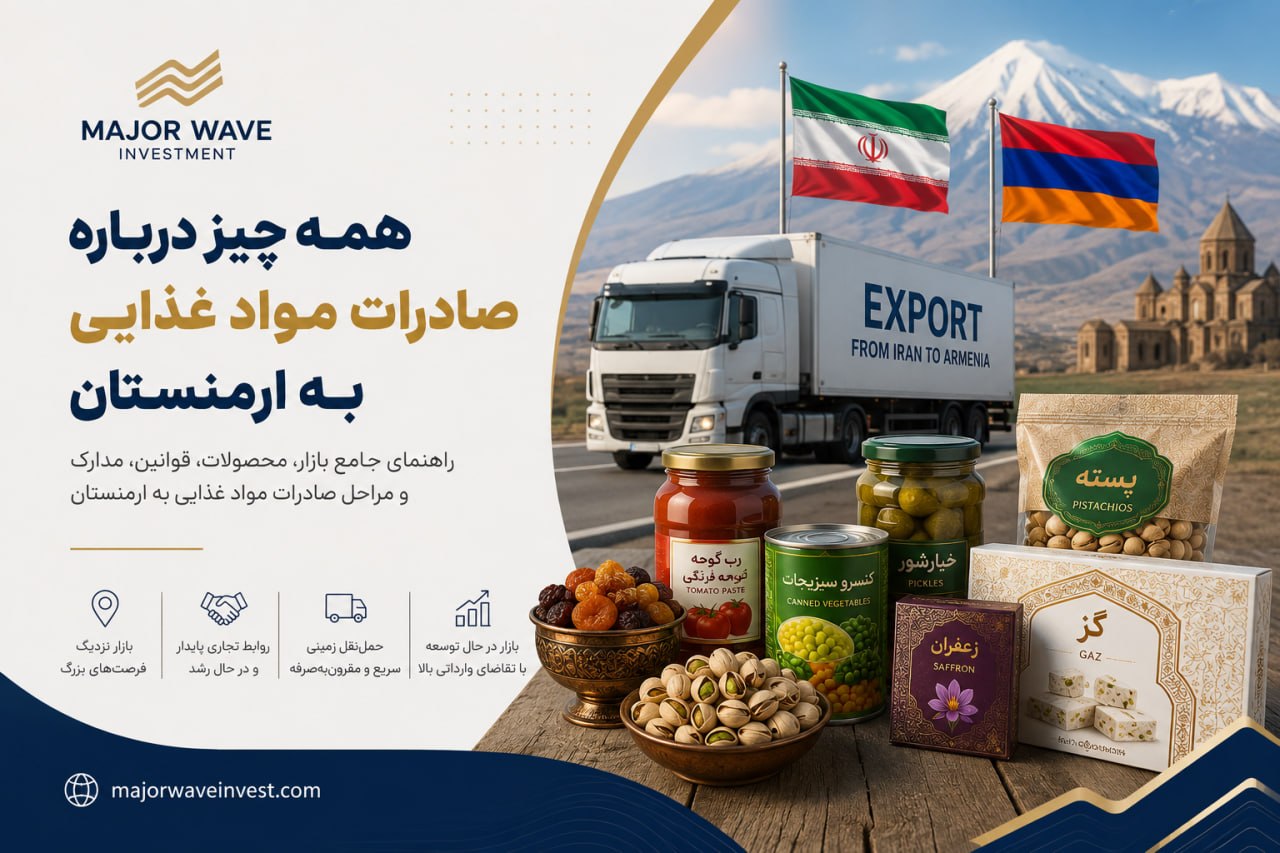
Everything about food exports to Armenia Armenia is one of Iran's closest export markets; A relatively small but accessible market that can be a suitable destination for Iranian food exports due to the common land border, the possibility of fast transportation of goods and trade relations between the two countries. Geographical proximity is considered an important competitive advantage, especially for products that have a limited use-by date or transportation costs determine their final price. The population of Armenia in 2025 is estimated to be around 3.1 million people. Although this country does not have a very large consumer market, its dependence on imports and the concentration of a significant part of the demand in Yerevan make it possible to target the market more precisely. In the first half of 2025, the total value of Armenia's imports was about 5.9 billion dollars, and Iran was among the important import partners of this country with more than 300 million dollars of goods exports; Of course, this figure is related to all product groups and does not include only food. Why is Armenia a suitable destination for food exports? One of the most important advantages of the Armenian market for Iranian exporters is direct land access. Iranian goods can enter Agarak region of Armenia from Tabriz, Jolfa, Marand, Mako and Nordoz border and then move to Yerevan or other cities of this country through Moghri. At the Agarak crossing, border control of food products, veterinary products and products subject to plant quarantine regulations is carried out. The second advantage is the implementation of the free trade agreement between Iran and the Eurasian Economic Union. The agreement entered into force on May 15, 2025 and provides preferential market access for about 90 percent of product lines. However, this does not mean that the tariff on all food items is zero; The final price of each product must be checked based on the tariff code or HS Code, the table of obligations, the rules of origin and the exceptions of the agreement. Other advantages of this market include the following:
Nuts and dried fruits
Everything about food exports to Armenia Armenia is one of Iran's closest export markets; A relatively small but accessible market that can be a suitable destination for Iranian food exports due to the common land border, the possibility of fast transportation of goods and trade relations between the two countries. Geographical proximity is considered an important competitive advantage, especially for products that have a limited use-by date or transportation costs determine their final price. The population of Armenia in 2025 is estimated to be around 3.1 million people. Although this country does not have a very large consumer market, its dependence on imports and the concentration of a significant part of the demand in Yerevan make it possible to target the market more precisely. In the first half of 2025, the total value of Armenia's imports was about 5.9 billion dollars, and Iran was among the important import partners of this country with more than 300 million dollars of goods exports; Of course, this figure is related to all product groups and does not include only food. Why is Armenia a suitable destination for food exports? One of the most important advantages of the Armenian market for Iranian exporters is direct land access. Iranian goods can enter Agarak region of Armenia from Tabriz, Jolfa, Marand, Mako and Nordoz border and then move to Yerevan or other cities of this country through Moghri. At the Agarak crossing, border control of food products, veterinary products and products subject to plant quarantine regulations is carried out. The second advantage is the implementation of the free trade agreement between Iran and the Eurasian Economic Union. The agreement entered into force on May 15, 2025 and provides preferential market access for about 90 percent of product lines. However, this does not mean that the tariff on all food items is zero; The final price of each product must be checked based on the tariff code or HS Code, the table of obligations, the rules of origin and the exceptions of the agreement. Other advantages of this market include the following:
Despite these advantages, the Armenian market is competitive, and Iranian products must have standard packaging, stable quality, adequate expiration dates, and acceptable labeling in addition to reasonable prices. What food items can be exported to Armenia? Product selection is the most important decision in the export process. A product that has high sales in the Iranian market will not necessarily be successful in Armenia. Before choosing a product, the status of domestic production in Armenia, competing products, store prices, supply season, shipping costs and consumer purchasing power should be checked.
Pistachios, raisins, dates, dried figs, dried berries, almonds and other products of this group are options to consider due to their good shelf life and the possibility of transporting them without a cold chain. Small and medium-sized packages with professional design are usually more suitable for entering retail stores than unbranded bulk packages. In this group, competitive price alone is not enough. Product size uniformity, humidity control, lack of contamination, packaging quality, and accurate inclusion of production and expiration dates are very important.
Sweets, chocolates, biscuits and snacks
Biscuits, wafers, cakes, chocolates, candies, gez, shavings, nougat, chips and snacks are products that can be offered in chain stores and supermarkets. In this group, the appearance of the packaging and the consumer price play a decisive role. In order to succeed in the Armenian market, it is better to coordinate the package weight, product sweetness and graphic design with the taste of the local consumer. Sending samples and conducting sales tests before entering into a long-term contract reduces the risk of entering the market.
Tomato paste, sauce and canned products
Tomato paste, all kinds of sauces, pickles, pickles, olives, canned vegetables, compotes and long-lasting prepared foods have export capacity due to their ability to be transported by land and good shelf life. In these products, the quality of the can or container, the resistance of the packaging to temperature changes, the health of the product lid, the formulation, the preservatives and the remaining time until the expiration date must be carefully controlled.
Fresh fruits and vegetables
Citrus fruits, kiwis, watermelons, melons, peppers, tomatoes, cucumbers, potatoes, onions and some greenhouse products can create export opportunities in periods when the Armenian market is faced with a lack of supply or an increase in prices. However, the export of fresh produce is very sensitive. Harvest time, grading, storage temperature, type of basket or carton, ventilation, phytosanitary certificate and border crossing speed directly affect the profitability of the transaction. A delay of several days may cause a drop in quality, price reduction or return of the shipment.
Drinks and juice
Juice, concentrate, fruit drinks, buttermilk and some non-alcoholic drinks can also be considered. Of course, the high weight of these products increases the share of shipping cost in the final price; Therefore, their export is more justified when the producer has a price advantage, a well-known brand or a suitable distribution network.
Dairy, meat and products of animal origin
The export of milk, cheese, yogurt, meat products, chicken, eggs, fish and other livestock products has more complicated regulations compared to dry food. These goods may require veterinary certification, production unit approval, specialized tests, cold chain and special import permits. The Food Safety Inspection Agency of Armenia is responsible for food conformity assessment and veterinary, sanitary and quarantine controls. Interim restrictions on the import of livestock products may also change based on disease status or regulatory decisions; Therefore, the conditions of each shipment must be inquired through the Armenian importer before production and loading. The rules of food export to Armenia Armenia is a member of the Eurasian Economic Union and the imported food must comply with the technical regulations of this union and the national regulations of Armenia. The most important general regulations in this field are:
For many foodstuffs, it is necessary to submit a declaration of conformity to Eurasian technical regulations. Certain products, including groups of specialty foods or novel products, may require government registration. The type of conformity assessment should be determined based on the nature of the product and its tariff code. Also, the Eurasian food safety regulations require manufacturers to create and implement procedures based on HACCP principles in the production process. Having valid safety and quality documentation, laboratory results and certificates such as ISO 22000 or similar certificates can facilitate the product approval process, but it does not replace the licenses and legal documents required for each product. Packaging and labeling requirements The packaging is the first part of the product that the Armenian buyer sees. Even a high-quality product will have little chance of entering the retail network if it has poor design, poor printing, or incomplete information. The product label should be prepared according to the regulations of the Eurasian Union and the national requirements of Armenia. The required information varies according to the type of product, but usually the following must be included on the packaging:
The final version of the label must be approved by the Armenian importer, conformity assessment company or regulatory consultant before mass printing. Using a Farsi or English label alone can cause problems in the stage of clearance or store supply. Usually, consumer information is prepared in Armenian and, if necessary, in Russian. Documents Required for Exporting Food to Armenia The exact documents depend on the type of product, but a commercial shipment will usually require a set of commercial, shipping, origin and health documents. Commercial documents
- Food Safety Regulation TR CU 021/2011
- Food Labeling Regulations TR CU 022/2011
- Special regulations for juices and fruit and vegetable products
- Regulation of edible oils and fats
- Dairy regulations
- Regulation of meat and meat products
- Regulation of additives, flavors and processing aids
- Exact product name
- List of compounds
- Net weight or volume
- Production date and expiration date
- serial number
- Storage conditions
- How to use, if needed
- Details and address of the manufacturer
- Details of the importer or responsible representative in Armenia
- country of origin
- Nutritional value
- Allergens and necessary warnings
- Eurasian conformity mark, if included
- Sales contract
- Pre-invoice and final invoice
- Packing list or packing list
- Full details of seller and buyer
- Insurance policy, if agreed
- Road waybill or CMR
- Export declaration
Documents related to origin and tariff
To use the privileges of the Iran-Eurasia Free Trade Agreement, the goods must comply with the rules of origin specified in the agreement and an acceptable document of origin must be presented. The mere production or packaging of goods in Iran, without complying with the rules related to the origin of raw materials and the amount of production operations, is not necessarily enough to enjoy a preferential tariff. Health and technical documents Depending on the type of goods, the following documents may be requested:
These documents are not the same for all products. For example, requirements for exporting raisins are different from cheese, canned fish or fresh vegetables. For this reason, it is necessary to inquire based on the tariff code and the actual specifications of the product. Stages of food export to Armenia. First stage: market research. At first, the price of the same product in Armenian stores, supplier countries, weight of packages, competing brands and sales channels should be checked. Visiting the Yerevan market in person or working with a local market research company can provide much more accurate information than internet surveys. Second step: Selecting the tariff code HS code is the basis for determining the tariff, permits, certificates and technical regulations. Choosing the wrong tariff code can cause the cost to be incorrectly calculated, the goods to be stopped at customs, or new documents to be requested. Step 3: Finding an Armenian importer or distributor In many cases, the local importer is responsible for filing the declaration of conformity, coordination with the laboratory, clearance and distribution. The financial credit, sales network, history of imports and the ability of the importer to collect claims must be checked before signing the contract. Step 4: Sending the sample It is better to send the product sample along with technical specifications, analysis, packaging images, suggested price and minimum order quantity to the buyer. The sample must be exactly the same as the product that will be delivered in mass production. Step 5: Calculating the final price To determine the competitive price, all costs must be calculated: product price + export packaging + domestic transportation + international transportation + insurance + border and clearance fee + possible tariff + import tax and duty + distributor fee + store profit margin Free trade agreement can reduce the customs tariff of some goods, but other costs, taxes and technical requirements still need to be calculated separately. Sixth step: Contract conclusion. In the contract, things such as detailed specifications of the product, standards, weight, number, packing method, Incoterms, delivery time, responsibility for obtaining permits, payment method, transaction currency, delay damage, terms of product return and dispute resolution authority should be specified. For land transport, rules such as FCA, CPT, CIP or DAP can be used; Choosing the right rule depends on the seller's and buyer's responsibility for shipping, insurance and clearance. Seventh step: Production, quality control and loading Before loading, the health of the packages, the production date, the remaining amount of the product's life, the serial number, the temperature of the goods and the compliance of the shipment with the documents should be controlled. For refrigerated goods, it is necessary to record the route temperature and use the right vehicle. Eighth step: clearance and distribution After the shipment arrives at the border of Armenia, the customs and sanitary documents are controlled. In some cases, it is possible to sample or test the product. After clearance, the goods are transferred to the importer's warehouse, wholesale centers, stores, restaurants or other sales channels. The best way to enter the Armenian market for an exporter who is entering this market for the first time is to send a large shipment, a risky decision. A more logical approach is a phased entry: first choose two or three products with a suitable shelf life. Then prepare the packaging for the Armenian market and send a limited shipment for test sales. After checking the speed of sales, consumer opinion, competitors' prices and returns, the volume of exports can be increased. For starters, dry, shelf-stable products such as packaged dried fruit, confectionery, biscuits, chocolate, pastes, sauces and preserves are usually easier to manage than dairy, meat and other highly perishable products. Common mistakes in exporting food to Armenia Exporting without market research Seeing a few Iranian products in Armenian stores does not mean that there is a wide demand for all brands. Successful sales depend on price, packaging, distribution network and advertising. Printing packaging before label approval can produce thousands of packages with incomplete information or mistranslations, which can result in high correction costs. First, the final plan must be regulated. Ignoring the remaining expiration date, the importer and store need time to clear, stock, distribute and sell. A product that has lost most of its useful life when it arrives has little commercial appeal. Pricing based on the Iranian market, the domestic sales price cannot be the basis of the export price. Shipping costs, tariffs, taxes, distribution, promotions, store discounts, and waste must be factored into the calculations. Improper choice of importer A buyer without a distribution network may clear the product but not be able to sell it. The ability to distribute goods in stores is more important than the ability to place orders. Ignoring the rules of origin of the preferential tariff is applied only when the goods have complied with the terms of the agreement and documents of origin. This issue is especially important for products where a large part of their raw materials are imported. Is it profitable to export food to Armenia? Exporting to Armenia can be profitable, but its profitability depends more on correct product selection and cost management than on market size. Short distance, the possibility of ground transportation and preferential tariffs are the main advantages; On the other hand, the limited size of the market, competition with Armenian producers and Russian and European brands, the cost of entering stores and the sensitivity of food regulations are among the challenges of this path. A product has a higher chance of success if it has these features:
- health certificate
- Quarantine or phytosanitary certificate
- Veterinary certificate for livestock products
- Results of microbial, chemical and toxic residue tests
- Eurasia Declaration of Conformity
- Government registration certificate for covered products
- HACCP documentation or food safety management system
- Technical specifications and product formulation
- A real advantage in price or quality
- Sufficient durability
- Packaging suitable for the destination market
- Ability to produce with consistent quality
- Sufficient profit margin for importer and store
- Complete technical and laboratory documents
- Possibility of regular and uninterrupted delivery
summary
Armenia is one of the significant markets for Iranian food exports due to its border with Iran, land transport route, active trade relations and membership in the Eurasian Economic Union. The implementation of the Iran-Eurasia Free Trade Agreement can also reduce the tariff cost of many goods, provided that the rules of origin and documentation requirements are properly observed. However, success in this market is not achieved by shipping products alone. Understanding consumer behavior, choosing a reliable importer, complying with Eurasian standards, designing an Armenian label, accurately calculating the final price, and starting export with a test shipment are the most important principles for entering the Armenian market professionally. Simply put, Armenia can be a good starting point for the development of food exports; But an exporter will last in this market who has a plan to create a brand, a distribution network and a regular supply instead of one-off sales. Frequently asked questions Is the tariff for food exports to Armenia zero? The tariff of all products is not zero. The Iran-Eurasian Economic Union Free Trade Agreement covers a large part of the product lines, but the rate of each product must be checked using the HS code, table of obligations and rules of origin. What are the best foods to export to Armenia? Dried fruit, dried fruit, sweets, chocolate, biscuits, paste, sauce, canned food, some drinks and seasonal fresh products are among the options that can be considered. The final choice should be made based on the market price, competitors, shipping cost and required licenses. Is it mandatory to insert the Armenian label? The label must comply with the Eurasian regulations and the national laws of Armenia. In practice, consumer information should be presented in a form that can be used and accepted in the Armenian market; Therefore, the Armenian version of the label should be prepared in coordination with the importer or regulatory consultant. What is the main route of transporting food from Iran to Armenia? The land route usually goes from northwest Iran and Nordoz border to Agarak and Moghri and then to Yerevan. For perishable goods, a refrigerated truck and a detailed transportation schedule should be used. Can Armenia be used to enter other Eurasian countries? Compliance with Eurasian standards can facilitate the future development of exports to other members of this union; However, the entry of goods into Armenia alone is not a license to export or sell freely and without formalities in all member countries. Customs regulations, rules of origin, commodity restrictions and destination country requirements should be reviewed separately.
This article provides general information and is not a substitute for individual legal, financial or banking review.